quarta-feira, 19 de agosto de 2015

Dicas que eu gostaria de ter se estivesse começando a desenvolver ios hoje

Source: http://stuartkhall.com/posts/ios-development-tips-i-would-want-if-i-was-starting-out-today

Vocabulary:

  1. outdated books
  2. This can be nasty


Text: iOS Development Tips I Would Want If I Was Starting Out Today
January 15, 2013
Making iOS apps is getting easier and easier with each new release of Xcode. However, all the new features and approaches means there are more options to choose from, outdated (=desatualizado) books and old documentation.

Back in my day it was so much harder - that's is true in many respects, but a much higher level of quality and features is expected now. The bar keeps rising, and that's a very good thing.

If I was starting out with iOS development today these are the things I would hope somebody would tell me.

Use ARC!
ARC is awesome, it removes a lot of the complexity of memory management we had to deal with previously. Although it's valuable to understand memory management, ARC makes life a whole lot easier.

As a (still) recovering C++ developer from many years ago, I fought it for quite a while. Also many popular libraries have gone ARC only, so don't fight it, go with it.

Prefer Blocks Where Possible
Blocks are awesome. They mean you write less code and clearer code.

There is a great tutorial on blocks here.

There are still times when delegates/protocols or NSNotifications make sense, but blocks should be your first consideration.

Beware Of Retain Cycles With Blocks
This can be nasty (=desagradável), rather than go into the details here check out this link.

Forget Threads, Use GCD
"A programmer had a problem, so he used threads, then he had two"

GCD has made life a lot easier, just don't forget to switch back to the main thread before doing anything with the UI:
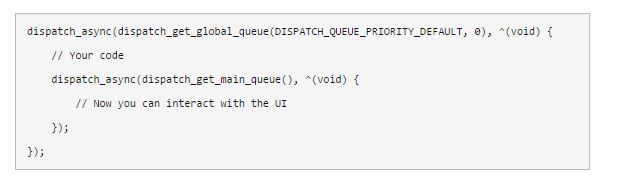


There is a good explanation of GCD, including making your own queues, here.

Singletons / Shared Objects
Carrying on with GCD, dispatch_once is really useful:


You'll be doing this a bit, especially when you see how costly it is to create things like NSDateFormatter many times.

Story Boards Are Just For Rapid Prototypes
In my opinion they are more pain than they are worth once you move beyond a basic project. Purely my opinion, some people love them. Make your own mind up on this one.

Only Use XIBs For Very Basic Layouts
There is so much you can't do in Interface Builder (IB). Any slightly "non standard" app with custom views move beyond IB's capabilities quickly. Still, I do use .xib's sometimes for the initial basic layouts, but I've read many people don't bother at all.

XIB's can also be a pain with source control and merging, it's much easier to merge code.

Keep Your Project Organised
I've done a bit of Ruby on Rails development and quite like the way they organise a project, so I do something similar in Xcode:

Xcode structure

However you do it, try and keep it in some sort of order, it will get out of hand pretty quickly.

Embrace Open Source
There are so many amazing libraries and components available for iOS development. Github is full of great source code that you can just drop into your project, you can also use sites like Cocoa Controls to find components.

Some libraries I use in almost every project include:

AFNetworking - Block based networking library, so easy to use and so powerful.
RegexKitLite - Powerful regular expression support
Facebook iOS SDK - Facebook support
If you Google for a component you need chances are there is one out there to at least get you started.

Dependency Management
With all these great open source components you'll need a way to manage them. CocoaPods has done an amazing job at making something similar to Ruby's gems. Otherwise you can just use git submodules.

Learn To Love Stack Overflow
There are a lot of really smart iOS developers on Stack Overflow, and chances are they have solved your current issue. Please search before asking a question, more often than not it has been answered before.

Graceful Degradation
Often you want to use functionality from a new version of iOS, but you also need to support older versions. There are many examples of this, Tweet Sheets in iOS 5, SKStoreProductViewController & UIActivityViewController in iOS 6, there are many examples.

Luckily at run time you can check if the class exists and fall back (or just throw up an unsupported message).


Custom Fonts
In early iOS versions (pre 3.2) this was a nightmare, so everyone just used Helvetica. Luckily now it's simple!

Here is a quick guide. If you get stuck with the name of the font open up Font Book and look for the PostScript name.

Localize From The Start
Localization is pretty easy to do in Xcode, especially if you avoid xibs. But add localization support from the start of your project, it's a long painful experience to extract them later.

Here is a great guide to localizing an iPhone app.

Track Crashes
Crash logs are a pain, a real pain. Use a service that captures and symbolicates them for you. Two great services are HockeyApp and TestFlight

Analyze
Product -> Analyze can pick up a lot of potential issues (and a lot of red herrings).

Instruments
Product -> Profile builds your code and launches Instruments. Instruments is a collection of invaluable tools to profile your app. First stop should be "Time Profiler" where you can see what is eating the CPU in your app. If you want to get your table view scrolling like butter you will be spending a lot of time in here.

Instruments

Track Reviews
<shameless self promotion>You'll have bugs, and people will write bad reviews in countries you may never heard of. Get them in your inbox daily with AppBot. </shameless self promotion>

I'm sure I've forgotten a bunch of things and not everyone will agree with everything above. Hopefully it will be useful to at least a few people just starting out in iOS development.

quinta-feira, 23 de julho de 2015

Estranho fenômeno musical 'orgasmos de pele'

Fonte: bbc

Vocabulário:

  1. bolt of lightning
  2. as chills or tingles
  3. endanger our survival
  4. arousal in response
  5. an outpouring of those sensations
  6. it is bland
  7. the boundary between the familiar
  8. as a penchant for pattern recognition


Texto:

By David Robson

22 July 2015
Sometimes music strikes the body like a bolt of lightning (=relâmpago). “I was in a friend’s dorm room in my third year as an undergraduate,” Psyche Loui remembers. “Rachmaninov’s Piano Concerto No. 2 came up on the radio and I was instantly captivated.” A chill down the spine, fluttering in her stomach, a racing heart – the musical movements still send the same feelings surging through her body to this day. “There are these slight melodic and harmonic twists in the second half that always get me!” she says.


Loui is an accomplished pianist and violinist, but you don’t need to be an expert for a song or score to electrify the senses in this way; it can strike anyone, anytime – in a cathedral or a shopping mall, at a wedding or on the Tube. You may know these physical feelings as chills (=calafrios) or tingles (=arrepios) – but some people feel them so powerfully, they describe the sensations as “skin orgasms”. “The aesthetic experience can be so intense that you can’t do anything else,” says Loui.
We normally only respond like this to experiences that might ensure or endanger (=por em perigo) our survival – food, reproduction, or the terrifying plummet of a rollercoaster. How can music – hardly a life-or-death pursuit – move the mind and the body as powerfully as sex? Years after her first dalliance with Rachmaninov’s concerto, Loui became a psychologist at Wesleyan University, and recently reviewed the evidence and theories explaining the phenomenon with her student Luke Harrison.

Loui and Harrison point out that the sensations can be extraordinarily varied beyond the shivers people normally report. A 1991 study of professional musicians and non-musicians, for instance, found that around half of all the respondents experienced trembling, flushing and sweating, and sexual arousal (=excitação) in response to their favourite pieces, as well as that familiar feeling of a shiver down the spine. Such varied and potent experiences may explain the origins of the term “skin orgasm”, and indeed, many cultures openly recognise the similarities. North Indian and Pakistani Sufis have long discussed an erotic dimension to deep music listening. Even so, Loui and Harrison tend to prefer the term “frisson”, since it avoids embarrassing connotations for experimental subjects describing their experiences.

As Loui has noticed herself with Rachmaninov’s concerto, people are often able to pick out specific measures that release an outpouring (=derramamento) of those sensations. Using those reports, researchers have then been able to pinpoint the kinds of features that are more likely to trigger the different sensations during a musical frisson. Sudden changes in harmony, dynamic leaps (from soft to loud), and melodic appoggiaturas (dissonant notes that clash with the main melody, like you’ll find in Adele’s Someone Like You) seem to be particularly powerful. “Musical frisson elicit a physiological change that’s locked to a particular point in the music,” says Loui. Our YouTube playlist below offers you some of the songs that seemed to elicit the most skin orgasms in lab subjects.
Goose Bumps

By asking subjects to listen to their favourite tracks while laying in an fMRI scanner, neuroscientists have then been able to map the regions of the brain that respond to chill-inducing tracks – helping them to chart some of the mechanisms that may correspond to this peculiar phenomenon. (See BBC iWonder’s interactive graphic of the brain’s response to musical tingles.)
Sweet anticipation

One major component seems to be the way the brain monitors our expectations, says Loui. From the moment we are born (and possibly before), we begin to learn certain rules that characterise the way songs are composed. If a song follows the conventions too closely, it is bland (=sem graça) and fails to capture our attention; if it breaks the patterns too much, it sounds like noise. But when composers straddle the boundary (=fronteira) between the familiar and unfamiliar, playing with your expectations using unpredictable flourishes (like appoggiaturas or sweeping harmonic changes), they hit a sweet spot that pleasantly teases the brain, and this may produce a frisson.

For instance, violated expectations seem to startle (albeit gently) the automatic nervous system, in its most primitive region, the brain stem - producing the racing heart, the breathlessness, the flush that can signal the onset of a frisson. What’s more, the anticipation, violation, and resolution of our expectations triggers the release of dopamine in two key regions – the caudate and the nucleus accumbens, shortly before and just after the frisson. You see a similar response when people take drugs or have sex, which may explain why we find shiver-inducing songs so addictive, says Loui. (Along similar lines, when pharmacologist Avram Goldstein at Stanford University blocked the brain’s opiate signalling - a system that controls reward and addiction - he found that it significantly reduced volunteers' ability to feel skin orgasms.)

Once you get to know a song, these feelings may become even more powerful. Even though you have lost the initial sense of surprise, you may have become conditioned to feel the frisson – just like Pavlov’s dogs salivating when the bell rang for their food.
On top of all this, a favourite piece of music will speak to our empathy as we try to imagine what the composer or singer was feeling. It will also evoke our memories as the song becomes entrenched in the central events of our lives. The result is a heady emotional cocktail whenever you listen to the piece – and it is partly why our taste is so individual, says Loui. “Our own autobiographical experiences interact with the musical devices – so that everyone finds a different piece of music rewarding.”


These insights are particularly interesting, when you consider the evolution of music. Some experts, such as the cognitive scientist Steven Pinker, have argued that music simply piggybacks on other cognitive machinery – such as a penchant (=propensão) for pattern recognition – that evolved for other, more important functions. It is, he says, no more than “auditory cheesecake”. “It’s that idea that music sure is yummy, but it’s not very nutritious,” explains Loui. In this sense, you could put skin orgasms in the same bracket as cocaine highs, or masturbation to pornography: pleasurable activities that just happen to hijack the brain’s responses to more basic human needs.

Loui, however, doesn’t subscribe to Pinker’s idea. Instead, she tends to prefer the idea that music is a “transformative tool” that helped us build the human mind and further society. Think of it as a kind of sandbox, she says. After we have performed all the most important duties to survive, we use music as an arena to play safely, train our minds and expand our experiences. During that playtime, we also use it to develop our emotional awareness, and to bond with others. “You don’t play alone in sandboxes but with other people,” she says. Music may have also helped us exercise our emotional communication.
If that’s the case, musical frisson could be our reward for exercising our minds and our societies in this way. There is no hard evidence, but Loui is intrigued by recent studies showing that the denser the wiring between the auditory, social and emotional parts of the brain, the more skin orgasms you feel. That could, perhaps, be a neurological signature of music’s social importance. Others have found that making music and dancing together produces more altruistic and cohesive groups, with one study finding that chill-inducing music is particularly good at promoting altruism in the lab’s subjects. Maybe it is the rush of endorphins from a skin orgasm that helps promote the communal goodwill.
These are just evolutionary just-so stories, of course. We may never truly understand why music first emerged. But even if it is just a form of auditory cheesecake, it is a legal high we could ill afford to live without today: it defines us, our friendships and offers a soundtrack to the most important moments in our lives. The fact it tickles the same pleasure centres as cocaine helps underline all these benefits, and means we will always keep coming back for more. As Loui herself might agree: who needs sex and drugs when you’ve got Rachmaninov?


quarta-feira, 22 de julho de 2015

Mariano Rivera é o último número 42

Source: http://www.nytimes.com/2010/04/15/sports/baseball/15rivera.html?_r=0

Novo vocabulário:

  1. I’ve been very pleased
  2. for so long from afar
  3. In late January
  4. by vexing issues
  5. demanding owner


Texto:

Yankees’ Mariano Rivera Is the Last No. 42

She had long wanted to meet him, but when they finally shook hands this past winter it was Mariano Rivera who was captivated by the presence of Rachel Robinson. He wears the number. She lived the legacy.

“It was wonderful,” he said. “I was honored.”
Mariano-Rivera-42

Rivera is the last of a dozen players who were allowed to continue to wear number 42 — made famous by Rachel Robinson’s husband, Jackie — when Major League Baseball retired it in 1997. It happened to be the same year Rivera became the Yankees’ closer.

Two years earlier, when the clubhouse attendant first handed Rivera his jersey, he was a 25-year-old Panamanian rookie with no idea that the number on the back symbolized the breaking of baseball’s color line on April 15, 1947.

But he has saved a few games over the last 13 years, always with a persistent professionalism. He grew nicely into greatness.

“Being the only one carrying the number right now, and forever, this means a lot to me,” Rivera said when asked about Thursday’s 63rd anniversary of Robinson’s big-league debut.

Yankee fans might actually believe that Rivera, 40, will pitch in perpetuity, given his competitive agelessness. But someday, nobody knows just when, the magic will leave Rivera’s slender right shoulder and 42 — at Yankee Stadium, at least — will carry even greater historical significance, if that is possible.

Given her deep Dodger roots and a soft spot for the Mets, Rachel Robinson has never been one to get her baseball fix in what was once sworn enemy territory, the Bronx. At 87, she attended opening day last week at Citi Field. But her plan was to be at the Stadium on Thursday night with her daughter, Sharon, and her grandson, Jesse Simms, for what has become an annual celebration of her husband’s indelible mark on American history.

The No. 42 jerseys will again be worn in major league parks, but only Rivera’s will be seen again and again, or with every jog in from the bullpen until, well, sometime within the next decade.

“I’ve been very pleased (=satisfeito) that he is the last one to wear Jack’s number,” Rachel Robinson said in a recent telephone interview. “I had admired Mariano Rivera for so long from afar (=tanto tempo longe).”

In late (=final) January, they were brought together when Rivera, along with Hank Aaron, attended a fund-raising reception for the Jackie Robinson Foundation in Lower Manhattan. In a Q. and A. forum, Rivera talked about “the privilege and the pressure” of wearing 42. The privilege was for obvious reasons, he said. The pressure was “because of the way Jackie Robinson conducted himself to make the best for his people, and for all minorities.

“So I know I am always watched, under the microscope,” he said.

Rivera paused, not for effect but because he is a serious, contemplative man. He added: “It’s a challenge, you know?”

Rachel Robinson said Rivera had nothing to worry about; he had long since risen to the number’s principles and behavioral standards.

“I believe there is integrity attached to it,” she said. “And I would hope it would always represent individuals who stand up for the things they believe in. I know that the Latino population has suffered through many of the challenges we have as African-Americans, so to have someone who conducts himself in the way Mariano Rivera does, that’s what we want to teach our young people.”

Unequivocally, Rivera said he does not consider himself a groundbreaker because he did not come first, or anywhere close to it, as Jackie Robinson had. All Rivera does is pitch and do what he can, quietly, in his community.

“After the legacy that Clemente, Cepeda, Marichal and many others left for us, I don’t think anyone can say anything about Latino players,” he said. “If there was something there before, something people didn’t like, I think it’s already changed.”

He might be surprised outside the big-market bubble, in a country that is polarized by vexing (=inquietantes) issues, immigration among them, said Alan Swyer, the director of “Beisbol, Yesterday, Today and Tomorrow,” a documentary on Latinos’ historical impact on the sport.

If early stereotypes — like the perro caliente, or hot dog — no longer resonate, new ones have arisen. “You have steroids, the idea that Latino players will take anything,” Swyer said. “You have the belief that they are front-runners or they aren’t team players — Manny being Manny. But Mariano is the flip side of Manny Ramirez. There is a dignity to him that is really important, especially as the U.S. becomes more Hispanic.”

On the game’s biggest stage, for baseball’s most credentialed team and most demanding (=exigente) owner, Rivera has looked in for the sign and right into the camera with a dispassion that borders on hypnotic.

“I think the key word is cool,” said Representative José E. Serrano, who represents the 16th District in the Bronx, describes himself as a Yankees fanatic and believes that Rivera has presented a very different kind of Latino face to American sports.

“I never thought there was anything wrong with playing with passion, but people didn’t understand the Latino culture,” Serrano said. “Mariano is so interesting because he just comes in, does the job, nothing flashy, like working people do every day.”

He has hardly been the only calm, collected Latino ballplayer, a lone Rivera, Serrano cautioned. He mentioned Bernie Williams, for one, but agreed that no one else had created such an aura facing forward while carrying the weight of No. 42 upon his back.

In January, Rivera told Rachel Robinson that he wore the number with great pride. “Every day,” he said.


quinta-feira, 25 de junho de 2015

Se ela soubesse que o vulcão estava em erupção não teria ido...

Fonte: scientific american

Vocabulario:

  1.  I just fetched my Mount St. Helens 
  2. for sorting out what I'll need 
  3. I'm working on
  4. flipping through the photos
  5. it's just overwhelming


Texto:

How I Wish I'd Known It Was Erupting At the Time...

Of course, if I'd know Mount St. Helens was actually erupting at the time, I'd probably have never gone. Volcano phobia, doncha know. I did haz one. But I thought all the eruptions were over, so I went up the mountain with my old friend Victoria, and didn't realize until long afterward that we'd been there during an eruption. Sometimes, they're that quiet!

I bring it up now because I just fetched (=busquei) my Mount St. Helens photos off the external hard drive in preparation for sorting out (=resolvi) what I'll need for the book I'm working on (note the preposition is not in). I couldn't resist flipping through (=folhear) the photos from that May 13, 2007 trip, and ran across the one Victoria took of me with my favorite volcano in the background. Alas, we only had my horrible old digital camera, so the pictures aren't spectacular, but this one turned out well enough for me to crop to a nicety.

That was such a great trip! The first time you visit Mount St. Helens, it's just overwhelming (=impressionante). You're passing through this beautiful, lush, verdant forest, and suddenly, boom - no forest. It's just gone. And there's this huge mountain with a ginormous gap in it right in your face. I don't think there's an actual way to prepare yourself to see that.

And if you were there in May of 2007, you'd have parked in the parking lot, stepped out, and seen this:

The parking lot was completely covered in burns. It was about then we began questioning the wisdom of bringing the cloth-top convertible. But hey, it was the fastest car we owned, and when you're both visiting an active volcano for the first time, even if you aren't aware that it's actually right-that-moment erupting, you bring the fast car just in case you need to flee. Well, that, and convertibles are cool.

So yes, you're looking into that serene, snow-covered crater and thinking I've lost a few of the more critical marbles. That doesn't look anything like an erupting volcano, right? But, my darlings, it was! Check it out:

In July 2007, the volume of the new dome was 93 million cubic meters (121 million cubic yards). This is slightly larger than the volume of the 1980–1986 dome. The new dome grew a small additional amount from August 2007 to January 2008, but a thick winter snowpack in the crater this winter prevents us from measuring that value accurately.

Dome growth during 2004-2008 lasted half as long (3 years) as the 1980-1986 eruption (6 years) while adding approximately the same amount of lava to the crater. The combined volume of the 1980-86 and 2004-08 lava domes is about 7 percent of the volume that was removed by the landslide on May 18, 1980, and 11 percent of the volume of the present horseshoe-shaped crater. The most obvious difference between the two periods is that dome growth during 1980–1986 was episodic, with growth spurts that lasted from a few days to nearly a year, interspersed with periods of no growth that lasted from several weeks to almost a year. In contrast, dome growth during 2004–2008 was continuous from October 2004 to January 2008. [emphasis added]

So while we were doing our glamor shots there, and having ecstatic fits over how cool everything was (and I was celebrating all the dry dirt - I mean, you have no idea how happy dry dirt makes you when you've just come from Arizona to Western Washington and thought you'd never see any actual dry dirt ever again), Mount St. Helens was quietly building her dome. Yes, snow could accumulate on parts of it. Yes, all looked serene. But Victoria and I noticed wisps of steam here and there - though, sadly, it's hard to tell what's steam and what's blowing snow with that crappy camera - and there were those scorch marks. So we knew something was up!

I don't know if it was hot enough then for infrared to show it well, but here's a spiffy image from 2004 showing you that you can have your fire and your ice, you betcha!

Totally looks like a campfire up there, doesn't it just?

Alas, the volcano is not busy dome-building today, so I have no eruption photos with my nice current camera. Perhaps soon. You see, she's definitely not done. Just resting.

Now, a lot of you lately have been not-so-subtly nudging at me to get a book out about Mount St. Helens. So I have created a not-so-subtle meme for you. You can download it, print it, and hang it up in a prominent place.

The book on the eruption will take some time to complete, but it's in progress. I'm also working on a west-side guide which I hope to have out by the end of summer. So, y'know. Be ready for that. I'm off to work on it now, actually. Bye-ee!

segunda-feira, 22 de junho de 2015

Explicitação da dívida do avanço da Grécia

Fonte: bbcnews

Vocabulary:

  1. has spelled out the terms
  2. and wages towards business
  3. dozens of riot police
  4. Talks have been in deadlock
  5. savers withdrew more than €4bn in recent days.
  6. of a possible breakthrough


Text:
Greece's economy minister has spelled out (=explicou claramente) the terms of new proposals to end deadlock on its debt crisis, amid hopes a deal can now be struck this week.

It includes new taxes on businesses and the wealthy, Giorgios Stathakis told the BBC in an exclusive interview.

Eurozone finance ministers have welcomed the plan, saying there could be a deal "within days".
Greece will default if it does not repay a €1.6bn (£1.1bn) IMF loan by the end of the month.

If that happens, it risks crashing out of the single currency and possibly the EU.

Eurozone leaders are currently discussing Greece's proposals at an emergency summit in Brussels.

Mr Stathakis told the BBC's Robert Peston he was confident the new proposals to balance the government's books had broken the deadlock with its creditors.

"We [will] try to remove the tax burden from pensions and wages (=salários) towards business and the wealthy," he said.
He said the proposals also included an increase in the VAT rate for some selected items.

Greece's economy minister Giorgios Stathakis told me that his Syriza government, led by Alexis Tsipras, had avoided crossing its red lines with the new proposals.

So, he said, there would be no further reductions in pensions or public-sector wages. And there would be no increase in VAT on electricity.

He also said that the government had agreed with the IMF and eurozone governments that the targeted budget surplus would be 1% of GDP or national income this year, 2% next year and 3% the year after.

There will be no agreement with creditors to cut Greece's massive burden of debt, despite Syriza's earlier insistence on this. But Mr Stathakis told me he expects eurozone government heads to issue a communique later saying that debt relief will be on the agenda for negotiation in coming months.
Read more from Robert
minister-greece-economy

Meanwhile, dozens of riot (=choque) police have been deployed to prevent clashes between anti-austerity and pro-euro protesters gathered outside the Greek parliament building.

Speaking ahead of Monday's summit, European Council President Donald Tusk said the latest Greek proposals were the "first real proposals in many weeks".
"This evening I want all cards on the table. That doesn't mean I want to negotiate technical details, but it means I want to end this political gambling," he said.

French President Francois Hollande, also attending the meeting, said he saw improvements with the proposals but warned "not everything has been resolved".

Talks have been in deadlock (=impasse) for five months. The European Commission, the IMF and the European Central Bank (ECB) are unwilling to unlock the final €7.2bn tranche of bailout funds until Greece agrees to economic reforms.

The European Central Bank (ECB) has again increased its emergency funding for Greek banks after anxious savers withdrew (=retiraram) more than €4bn in recent days.

Greek PM Alexis Tsipras, who has ruled out pension cuts, higher power rates, and an excessive budget surplus, said he hoped Greece would "return to growth within the eurozone".

He met the heads of Greece's three international creditors in Brussels, ahead of his talks with the leaders of 18 other eurozone nations later on Monday.

'Broad and comprehensive'
But eurozone finance ministers said they were not given enough time to study them for a proper assessment, amid confusion over different versions of the Greek proposals submitted.

Speaking after the meeting, Mr Dijsselbloem described the proposals as "broad and comprehensive", but said work was needed to check they added up "in fiscal terms".
One of the key power-brokers, European Commission chief Jean-Claude Juncker, told reporters his goal was to find an agreement "by the end of the week".

Earlier, Germany's Wolfgang Schaeuble told reporters he had not seen anything new from Greece so far and "without anything new, there is nothing for the ministers to prepare for their leaders". The Irish and Finnish finance ministers echoed the sentiment.

News of a possible breakthrough (=avanço) gave a boost to European stock markets, with Greece's main stock exchange jumping 9% by the end of trading on Monday.
The deadline for Greece to pay back a slice of its loan is 30 June, but a last-minute deal would make it difficult to arrange the logistics of transferring the money.
A separate European Council summit is scheduled for Thursday and Friday, and its agenda is packed.

Greek debt talks: Main sticking points
Greece will not accept cuts to pension payments or public sector wages, saying two-thirds of pensioners are either below or near the poverty line
International creditors want pension spending cut by 1% of GDP - it accounts for 16% of Greek GDP. They say they want to target early retirement, not lower-income pensioners
EU officials say Greece has agreed to budget surplus targets of 1% of GDP this year, followed by 2% in 2016 and 3.5% by 2018; Greece says nothing is agreed until everything is agreed
Creditors also want a wider VAT base; Greece says it will not allow extra VAT on medicines or electricity bills
Greece complains creditors focus on increasing taxes instead of cracking down on tax evasion; IMF is concerned Athens is not offering credible reforms

quinta-feira, 18 de junho de 2015

Garoto de 21 anos mata 9 pessoas na igreja

Fonte: bbcnews

Vocabulary:

  1. to reckon with the fact
  2. trickle of people arrive
  3. surveillance cameras showing
  4. prompted angry protests


A 21-year-old man suspected of killing nine people at a historic African-American church in Charleston, South Carolina, has been arrested.

21-year-killer-church
Police said Dylann Roof, of Lexington, South Carolina, was detained during a traffic stop in Shelby, North Carolina.

The gunman is reported to have sat in on a bible study meeting for a full hour before opening fire on the group.

Six women and three men, including the church pastor, were killed. A hate crimes investigation has been launched.

Who is shooting suspect Dylann Roof?
US President Barack Obama said he and his wife had known several members of the Emanuel AME Church, including the pastor, Clementa Pinckney.

He called the church a "sacred place" in the history of Charleston and spoke of his confidence that the congregation and the community would "rise again".
He also raised the issue of gun ownership, saying "communities like this have had to endure tragedies like this too many times".
"At some point," he said, "we as a country have to reckon (=contar) with the fact that this type of massacre does not happen in other advanced countries".

The streets close to the church are deserted, save for a few uniformed police officers. A trickle (=m pouco) of people arrive to lay flowers for the victims.

"Peace for the church, the family and their loved ones," reads one handwritten note, tucked into a bouquet of bright flowers. A short drive away mourners have arrived for a vigil in memory of the deceased.

Rev Vanessa Johnson is from a nearby church but knew one of the reported victims, the Reverend Clementa Pinckney.
"All of us are in shock... We are at a loss for words," she says. The Emmanuel church holds a special place in this city's hearts, she adds, making the events of Wednesday night so difficult to digest.

The weekly bible study meeting was under way in the church on Calhoun Street when the shooting unfolded at about 21:00 local time (01:00 GMT Thursday).
Charleston police chief Gregory Mullen said that when police arrived at the scene eight people were already dead in the church and one other person died later in hospital. There were three survivors, he added.

Police released images from surveillance (=segurança) cameras showing a suspect they described as white and clean shaven with a slender build, entering the building an hour before the shooting.
He was later seen driving away in a black four-door saloon car.
Police and officials were quick to call it a hate crime, and the US Department of Justice said it would open a federal hate crimes investigation.
Speaking after the arrest, Attorney General Loretta Lynch said they would be "looking at all of the facts, all of the motivations" to determine the best way to prosecute any case.

The killings have sent shockwaves through a community that has already experienced heightened racial tension in recent months.
The shooting two months ago of Walter Scott, an unarmed black man by a white police officer in North Charleston, prompted (=levaram) angry protests. The officer has since been charged with murder.
Clementa Pinckney, the 42-year-old pastor of the church, was also a Democratic state senator in South Carolina.
He had recently sponsored a bill to make body cameras mandatory for all police officers in South Carolina in response to the death of Walter Scott.

terça-feira, 16 de junho de 2015

Rússia aumenta 40 mísseis em seu arsenal nuclear

Source: bbcworld

New vocabulary:
  1. able to overcome 
  2. Amidst the rising tensions
  3. have been withdrawn
  4. arsenal has been shrinking
President Vladimir Putin says Russia will update its nuclear arsenal with more than 40 intercontinental ballistic missiles in 2015.

Speaking at an arms fair, Mr Putin said the weapons would be able to overcome (=superar) even the most technically advanced anti-missile defence systems.
It comes after the US proposed increasing its military presence in Nato states in Eastern Europe.

Tensions are high over Russia's role in the conflict in eastern Ukraine.
Nato and Western leaders accuse Russia of sending soldiers and heavy weapons, including tanks and missiles, to the pro-Russian separatists in eastern Ukraine. Russia has repeatedly denied this, insisting that any Russians fighting there are "volunteers".

'Arms race'
The 40 nuclear missiles that Mr Putin referred to on Tuesday are not additional missiles, but replacements for old ones, says the BBC's Sarah Rainsford in Moscow.
The new ones are more high-tech and capable of penetrating anti-missiles defences, our correspondent adds.
Russian officials have warned that Moscow will respond if the US carries out its plan to store heavy military equipment in Eastern Europe, including in the Baltic states that were once part of the Soviet Union.

"The feeling is that our colleagues from Nato countries are pushing us into an arms race," RIA news agency quoted Russian Deputy Defence Minister Anatoly Antonov as saying on the sidelines of the arms fair outside Moscow

Analysis - Jonathan Marcus, BBC News defence and diplomatic correspondent

Amidst (=em meio) the rising tensions with the West, Russian President Vladimir Putin has placed a renewed emphasis upon his country's nuclear arsenal.
This is in part a reflection of Russia's continuing conventional military weakness. Moscow is in the midst of a significant modernisation of its strategic nuclear weapons with new ballistic missiles being deployed, more modern bombers, and new submarines being launched.

Over recent years, older, obsolete weapons have been withdrawn (=retirados) from service, so the size of Russia's overall arsenal has been shrinking (=encolhendo).
However, this decline could soon come to an end, raising all sorts of questions for other nuclear powers.

What most alarms the West is the renewed emphasis in Russian rhetoric on nuclear rather than conventional forces.
Threats to deploy short-range nuclear weapons in Crimea have been accompanied by veiled warnings of nuclear targeting against Nato members who might host ballistic missile defences.